

Quiet eye is the last steady fixation before a decisive act. The research on what it is and who has it is set out in full on The Quiet Eye. This is the other half of it. Knowing where an expert looks changes where you put a camera, when you roll, and when you stop.
The camera usually arrives too late
Watch any broadcast of any sport and count how often you see the moment before. You will not need many fingers. The cut lands on the ball leaving the club, the wheel touching the line, the arm going up. Coverage is built to capture the result, because the result is what the rights were sold on and because the result is unambiguous.
The trouble is that the result is the least interesting part. By the time it happens the decision has already been made. It was made a second and a half earlier, in a still head and a fixed gaze, and almost nobody films that.
What an analyst is looking at
I spent years on the World Cup circuit as a performance analyst before I did this for a living, and the job trains you out of watching the wrong thing. You stop following the athlete and start watching what the athlete is watching.
On a mountain bike course that means the head, not the bike. A rider who has committed to a line looks through the corner well before the front wheel gets there, and the head stops moving. A rider who has not is still hunting, and you can see the search in small corrections of the chin. Nothing about the bike tells you this. The head tells you all of it, and it tells you two or three seconds before the corner resolves.
Once you have seen that you cannot unsee it, and it becomes very hard to point a camera at the corner.
Where we put the camera because of it
Three things follow from this, and they are all about restraint rather than equipment.
We stay wide on the approach. A long lens tight on the hands is a beautiful shot and it throws away the only information that matters, because it crops out the face. If we have one camera and a choice, the face wins.
We roll early and we hold. The temptation is to start on the action, which guarantees you miss the settle. We start well before, and we keep rolling after, because the second or two following a decisive act carries the reaction and the reaction is what an audience actually remembers.
We do not cut on the result. Almost every edit wants to leave the moment the ball drops. If the shot is doing its job the interesting frame is the one after that, and it is usually still there in the rushes because nobody thought to look.
It is not a trick, it is an argument
None of this is a technique you bolt on. It comes from having stood in the sport rather than at the side of it, and it is the reason two people who came out of performance sport make different films from a crew who came out of advertising.
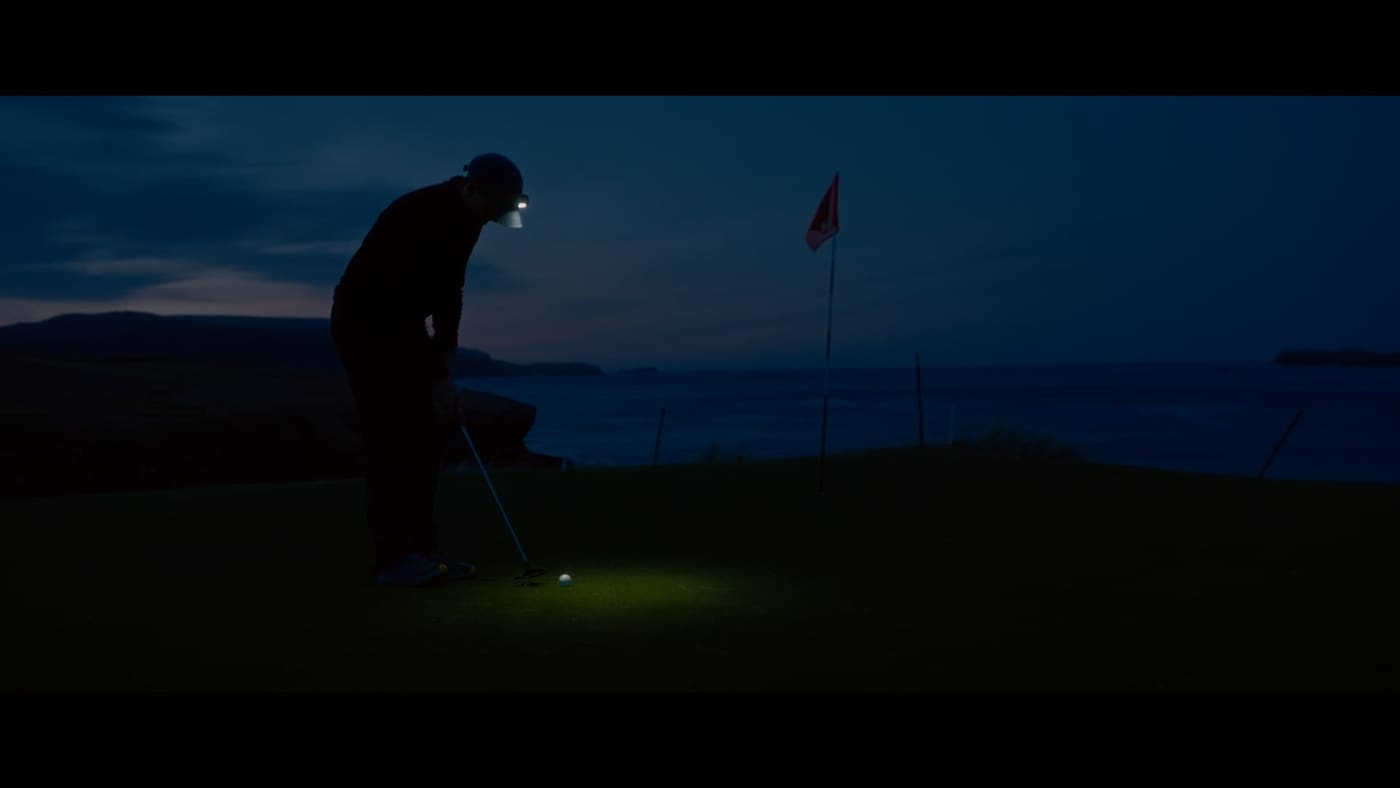
You can watch it play out on a golf course in the dark in Chasing Light, where the whole day was a race against the light and every shot at Durness was taken with less of it than the one before. The gaze holds anyway. That is the thing worth filming.