

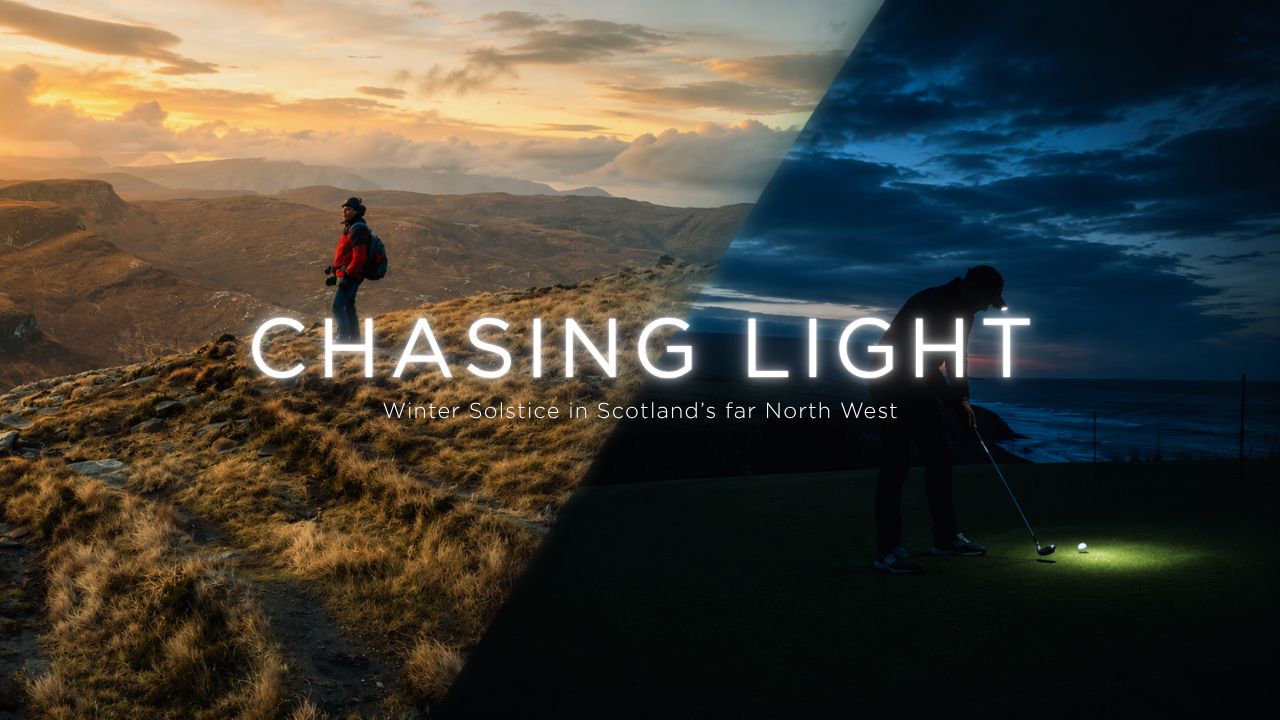
We made Chasing Light in a single day, 21 December 2025, with two people and no crew. Harry Whiteley and I climbed Ben Hope, the most northerly Munro in the UK, by head torch, then drove to Durness and played nine holes before the winter solstice ran out of light. The film runs just under eleven minutes.
Why make a film on the shortest day of the year?
Because the day was already booked. We were meant to be in the far north west of Scotland making a different film, plans changed, and by then the equipment was packed and the trip arranged. We make sport and adventure films for other people, so rather than stand the day down we turned it on ourselves.
The solstice did the rest. On 21 December the far north of Scotland gets only a few hours of usable light, and we set ourselves two things to do in it that both depend on seeing: a mountain and a round of golf. A constraint like that makes most of the decisions for you before the day starts. What it leaves are the ones that matter.
What was the climb up Ben Hope like?
We set off at six in the morning with about two and a half hours of climbing ahead of us before any light would appear. For most of the ascent the world was a pool of torchlight perhaps five metres across. That turned out to help more than it hurt. When you cannot see how steep the next section is or how far the summit is, you keep putting one foot in front of the other.
The hill got harder as we went. We stopped for a long snack at about 600 metres and climbed on into fog. Roughly 100 metres below the top the temperature dropped below freezing and the ground turned to ice. The wind was not gusting. It blew continuously at 40 to 50 miles an hour, towards a sheer cliff face on our left, for the whole of the upper climb.
We reached the summit just after half past eight, still in darkness and gloom. There was no view at all, only cloud and wind, and we did not stay. The reward came on the descent. Below the cloud the sun had come out, and the lower slopes of Ben Hope opened up in the low winter light.
How do you film a climb you cannot repeat?
You shoot it as you climb, because there is no version of the day where you come back and do it again. There were two of us on the hill, no second operator and nobody standing by if a camera failed. In that wind your hands stop working long before the camera does, and the lens fogs every time you breathe near it. The craft side of shooting by head torch, and what a worn light does to a frame, is set out in How do you film sport and adventure in the dark?
What was the one decision that shaped the film?
To commit to the single day and let it be real. No staging, no second attempt, no waiting for better weather. If the cloud never lifted, that was the film. That is a risk, and it is also the whole point. The jeopardy on screen is the jeopardy we actually felt. You cannot fake a race against the light. You can only run it.
What happened at Durness Golf Club?
Off the hill and straight to the coast. Durness Golf Club is the most north westerly course on the British mainland, nine holes laid out above a bay, with big dunes in the distance, the hills behind and the North Atlantic at the edge of the fairway. The land doubles as grazing, so you play around sheep, and the greens are fenced against them. There are blind shots everywhere, and on a first visit a fair amount of time goes on agreeing which green you are actually aiming at.
We played it as a match and we played it out properly. Harry took the first hole and I took the next one straight back. From there he won a run of holes and went three up with three to play. We halved the par three seventh in fives, played downhill over the sheep, and that was the match.
The ninth is the hole the film was always heading for. It asks for a wedge across sea, cliff and rock to a small raised green, and by the time we stood on the tee there was almost no light left to see it by. That one shot sums up the day better than anything I could write about it. The putt that followed, taken by head torch, is a frame we took apart in Durness, and what a tight shot would have missed. The golf from that afternoon also stands on its own as a short film, Winter Solstice at Durness Golf Club.
How was Chasing Light edited?
In the order it happened. The structure came from the clock rather than a script, so there was never any other order available, and the cut runs from head torches at six in the morning to the last of the light on the ninth green. The final words spoken in the film are that next time there would be less camera equipment. After a night climb in ice and wind, that is advice rather than a joke. Every extra item on a two person shoot in the dark is one more thing to find by torchlight and change with numb hands.
Why is it called Chasing Light?
Every choice in the film comes back to one thing, the light, and how little of it there was. That is the idea the whole company is named for: the held focus in the moment that decides everything, on the hill and on the fairway. The research behind it is set out on The Quiet Eye, and the full film is on the Chasing Light page.