

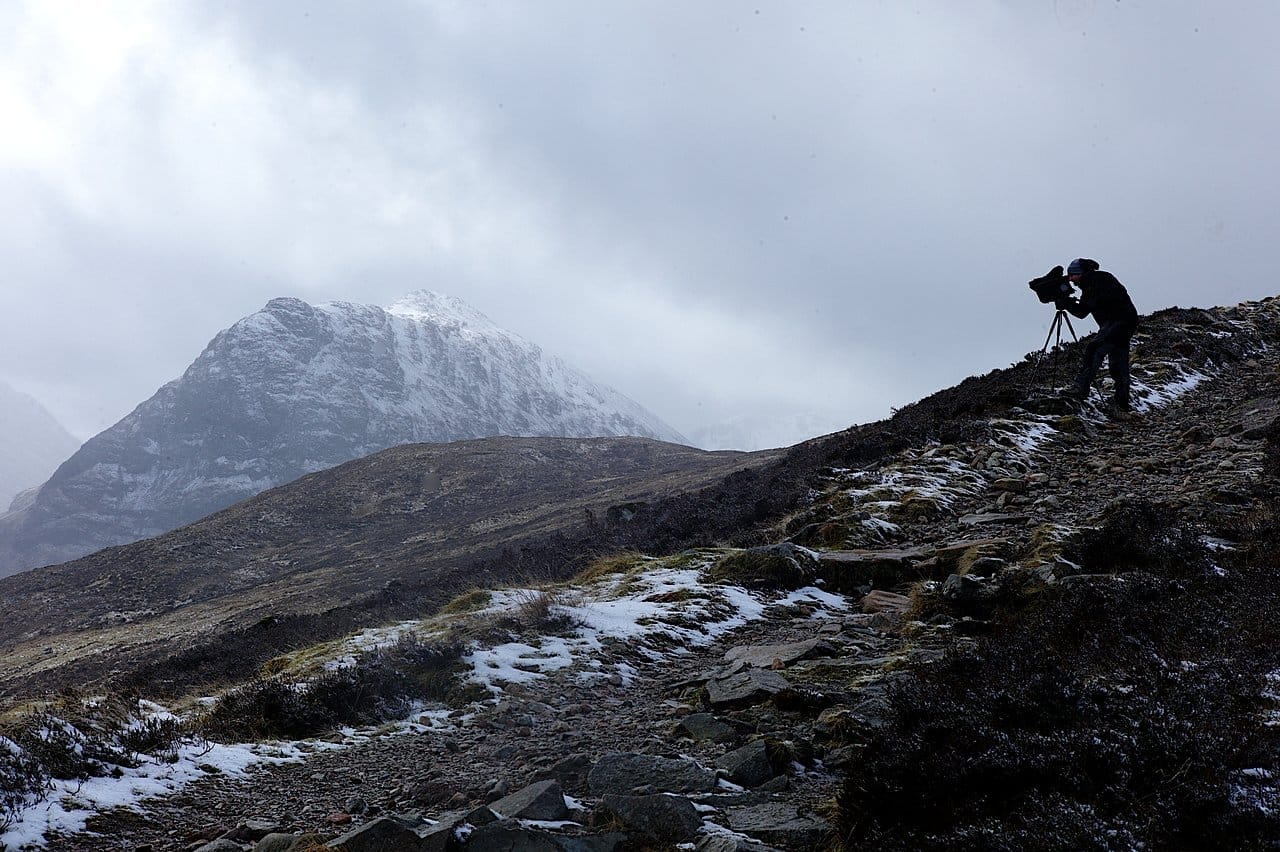
A scientist’s eye brings observation before opinion. Before I made films I spent years as a geomorphologist, mapping landslides across Scotland and Ireland and leading river restoration, and time as a performance analyst on the UCI Mountain Bike World Cup circuit. Both jobs teach the same discipline. Watch closely, record honestly, and let the pattern show itself. That is exactly how you make an honest film.
What does a research background actually teach?
It teaches you to look before you decide. In science you do not arrive with the answer and bend the data to fit. You gather what is in front of you and you let it speak. A landslide does not care what you expected. Neither does an athlete on a bad day. The habit that matters is the same in both fields. Sit with what is real for long enough to understand it, then tell it straight.
I did a PhD in geomorphology at the University of St Andrews and worked as a consultant mapping ground movement and restoring rivers. That is not the usual road into a camera department. It gave me project discipline, patience and an eye trained to read a scene for what it is, not for what would be convenient.
How does performance analysis change how you film sport?
It changes what you look at. As an analyst on the mountain bike World Cup I studied riders for the small things that decide a race. Line choice, body position, the fraction of a second where a run is won or lost. You learn that the decisive moment is rarely the loud one. It is a quiet adjustment most people miss.
That is the moment we build films around now. The held focus before the effort, the calm before it goes wrong or right. It is the same idea we took our company name from, the quiet eye. Read the full account on The Quiet Eye.
Why does this matter for the films?
Because sport deserves better than the highlight edit. Analysis taught me what actually matters inside a performance, and filmmaking is how I show it. Two decades as a cinematographer, editor and colourist, on BBC documentaries and alongside British Cycling and Scottish Rugby, sit on top of that scientific training. The craft makes it cinematic. The science keeps it honest.
We do not chase trends. We tell stories that stick. See how the two paths meet in our work and in our story.
Chasing Light is the clearest example. We built a whole film around a measurable constraint, the few hours of usable light on the winter solstice in the far north west of Scotland, then climbed Ben Hope in the dark and raced the setting sun to play golf at Durness. That is a scientist’s way to plan a shoot.